At the beginning of 2026, the marketing team for one of my projects consisted of one person: me. There was enough work, though, for a social media specialist, an email marketer, a performance marketer, a growth manager, and someone to handle outreach.
I didn't have the budget for that team. So I decided to test a different idea: could I build a marketing operation with autonomous AI agents while keeping strategy, priorities, and quality control in my own hands?
This isn't a story about replacing six people. I didn't lay anyone off; I simply didn't hire them. And that distinction matters: six agents are not the equivalent of six experienced specialists. What they gave me was the capacity to do work that a one-person team couldn't otherwise get through.
From copilot to team
I had already used Claude and ChatGPT as copilots. They helped me draft, brainstorm, and analyze, but the work still lived in my head. I had to remember the task, gather context, open a chat, write the request, check the response, and move the result into the right tool.
A copilot speeds up a single action. An autonomous agent should pick up a task on its own schedule, carry it out according to its rules, stop when a decision is needed, and deliver the result where we've agreed it belongs.
When I saw that OpenClaw could support a system of autonomous work rather than just one chatbot, I decided to put together another team—this time, of agents.
How the team worked
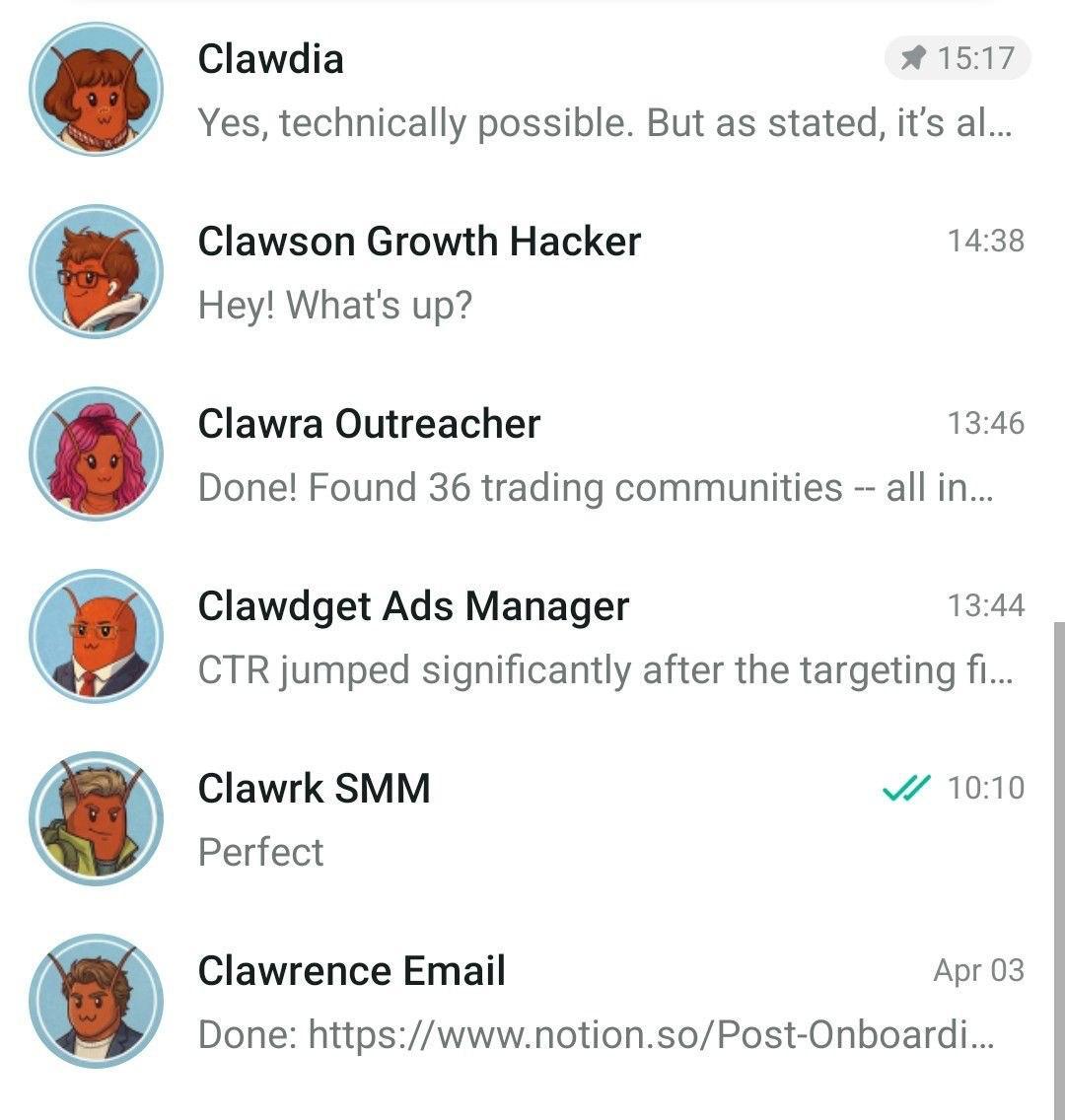
The system had six agents with separate roles:
- The orchestrator coordinated the other agents and consolidated their reports.
- The social media agent prepared and published content across social platforms.
- The email agent assembled newsletters.
- The ads agent worked on campaigns in Meta and Reddit.
- The growth agent looked for growth opportunities and tested hypotheses.
- The outreach agent communicated with influencers.
The team ran on a rented server. OpenClaw managed the processes, with Claude models doing the work underneath. Each agent had its own instructions, access permissions, schedule, and reporting format. The orchestrator passed tasks between them and collected the results.
Getting one agent running took about two weeks of my time. I had to define the role, connect tools, limit access, set up reporting, watch for early mistakes, and rewrite the rules. It felt closer to onboarding a new employee than writing a good prompt.
The work they handled
Over two full months, the team produced:
| Channel | Result |
|---|---|
| Blog | 20 articles |
| Social media | About 195 posts for seven platforms |
| 4 newsletters | |
| Outreach | About 43 influencer contacts in the pipeline |
| About 433 comments | |
| Paid acquisition | 2 ad accounts with campaigns running continuously |
My own work changed beyond recognition. I spent less time writing and more time reading: morning reports, spot-check results, and questions where agents had stopped to wait for a decision. My role started to feel like a combination of editor-in-chief, head of marketing, and operations lead.
What changed in the business metrics
At first, I didn't set separate KPIs for the agents. The goal was simply to handle work that consistently wouldn't fit into my day. But over the first nearly three months, the numbers changed too:
- organic traffic grew 7×;
- referral traffic grew 10×;
- average cost per lead fell 30%, with the ad budget unchanged;
- Reddit posts received 135,000 views;
- the subreddit gained 300 organic subscribers, who continued to bring in traffic.
Other project metrics grew as well, but there the agents' work overlapped with product development. I'm leaving those numbers out of this case study because I can't honestly separate one factor from the other.
The main result wasn't the volume of content. The system brought consistency: channels no longer depended on whether I had any energy left after strategic work.
What it cost
In May, the six agents and their infrastructure cost $359 for the month. They operated within a single $200 Claude Max subscription. By my estimates at the time, the same volume through the API would have cost roughly ten times as much.
But $359 isn't the full cost. The most expensive part of the system never appeared on an invoice: my time spent setting it up, checking outputs, correcting rules, and making decisions in ambiguous situations. Even after launch, the agents needed management—much like a new hire who is already useful but doesn't yet know every exception.
So comparing $359 with the salaries of six people would be misleading. A better question is how much additional marketing capacity I got for that money and my own management time.
Where the system broke down
Agents confidently deliver wrong answers
My classic test is to ask for ten sources. An agent finds seven, makes up two, and brings back one so irrelevant I almost admire its persistence. Then it presents all ten with the confidence of someone who has no doubts at all.
When an output can be verified, rules help: open every source, cite a specific passage, flag anything unconfirmed, and stop if there isn't enough evidence to reach the requested number.
Expertise became essential for checking the work
A model always brings its own idea of what a “normal” marketing process looks like. If you don't know the subject, you have no basis for pushing back. You take a convincing answer for a correct one and miss where the agent simplified, mixed things up, or invented something.
AI has shifted the value of expertise. It used to be an advantage to know how to do the work. Now the ability to judge the work is becoming more valuable. An agent makes a strong specialist faster. It can just as quickly help someone without the fundamentals produce convincing mistakes.
Memory needs management too
It seems that the more an agent remembers, the better it will work. In practice, its memory needs regular review and cleanup. Otherwise, old decisions, exceptions without context, and rules that now contradict each other pile up.
An agent's memory isn't an archive of everything that ever happened. It's a working environment. Only what helps with the next decision should stay there.
What I changed after the first team
After this project, I stopped starting with “what other agent should I build?” I look at the process first:
- Does the work repeat often enough?
- Can I describe a good result?
- Is there a reliable data source?
- Can an error be checked quickly?
- Where should the agent stop and ask a person?
- What access does it actually need?
If those questions don't have answers, autonomy will only speed up the chaos. If they do, an agent can take over a whole piece of operational work, rather than just one action within it.
Where to start
Don't start with six agents. Choose one task you know inside out. Define the role, data sources, access, criteria for completion, stopping points, and reporting format.
Then establish a review routine: spot-check results against primary sources and record recurring mistakes. Over time, that list will become more useful than the longest prompt.
And allow time for the agent to settle in. The first week shows what it's capable of. The next few weeks show how much management it needs to do the work reliably.
I share working notes on agents, where they fail, what they're useful for, and what they cost in the Alina Runs Agents Telegram channel. Practical materials and workshop recordings are available at Alina Runs Agents.